Comparison: Canadian and American Medical References
The automated test protocol ran 200 repeated queries per deployment against two distinct medical references: Toronto Notes 2022, 38th Edition (a Canadian reference for the MCCQE licensing examination) and Bates’ Guide to Physical Examination and History Taking, 13th Edition (a widely used American reference). This section compares recall quality across the two texts. All results are from the aggregated automated run (June 17, 2026; n = 200 per cell).
HTTP reliability differed sharply across deployments: only deepseek-agent had a substantial error rate (23.5–32.5% of requests); all other deployments, including gpt-oss-agent, completed every request successfully. Percentages for deepseek-agent are computed over successful responses only.
Table — HTTP Reliability
| Deployment | Toronto Notes 2022 (CA) | Bates’ Guide 13e (US) |
|---|---|---|
deepseek-model | 100% | 100% |
deepseek-agent | ~70–76% (error rate 23.5–32.5%) | ~70–76% (error rate 23.5–32.5%) |
deepseek-native | 100% | 100% |
deepseek-native-t1 | 100% | 100% |
gpt-oss-model | 100% | 100% |
gpt-oss-agent | 100% | 100% |
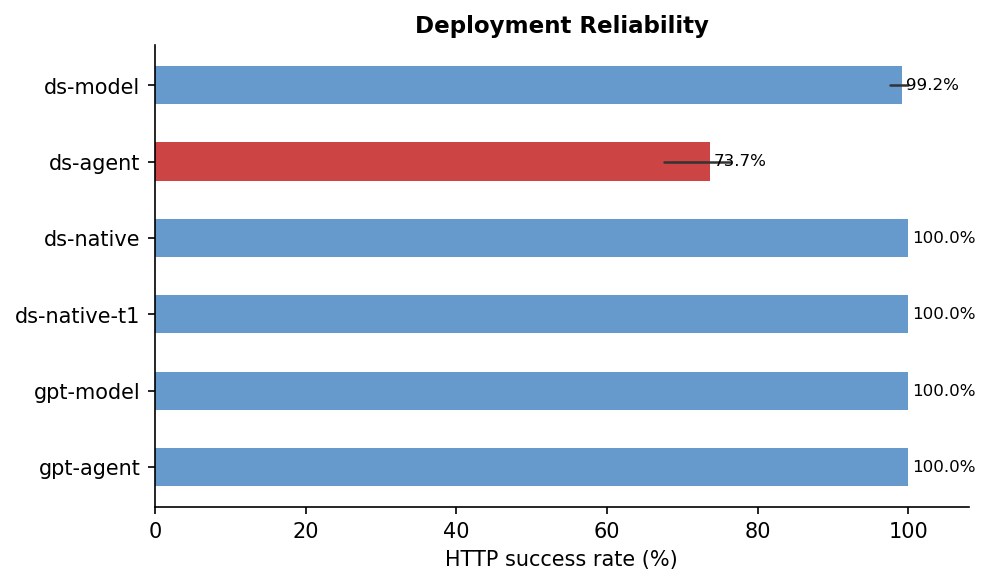
Mean HTTP success rate per deployment across all text–query combinations.
Generative recall (title to table of contents)
Each deployment was prompted with the full title of each work and asked to return its table of contents as a bulleted list. Coverage is the mean fraction of the reference headings present in the output across all successful runs; perfect recall (rcl*) is the fraction of runs in which the output contained every reference heading.
Table — Recall Coverage
| Deployment | Toronto Notes 2022 — Coverage | Toronto Notes 2022 — Perfect | Bates’ 13e — Coverage | Bates’ 13e — Perfect |
|---|---|---|---|---|
deepseek-model | 91.5% | 0% | 0.1% | 0% |
deepseek-agent | 87.0% | 0% | 7.7% | 0% |
deepseek-native | 93.0% | 0% | 0.3% | 0% |
deepseek-native-t1 | 89.5% | 0% | 0.2% | 0% |
gpt-oss-model | 12.5% | 0% | 0.5% | 0% |
gpt-oss-agent | 10.5% | 0% | 0.4% | 0% |
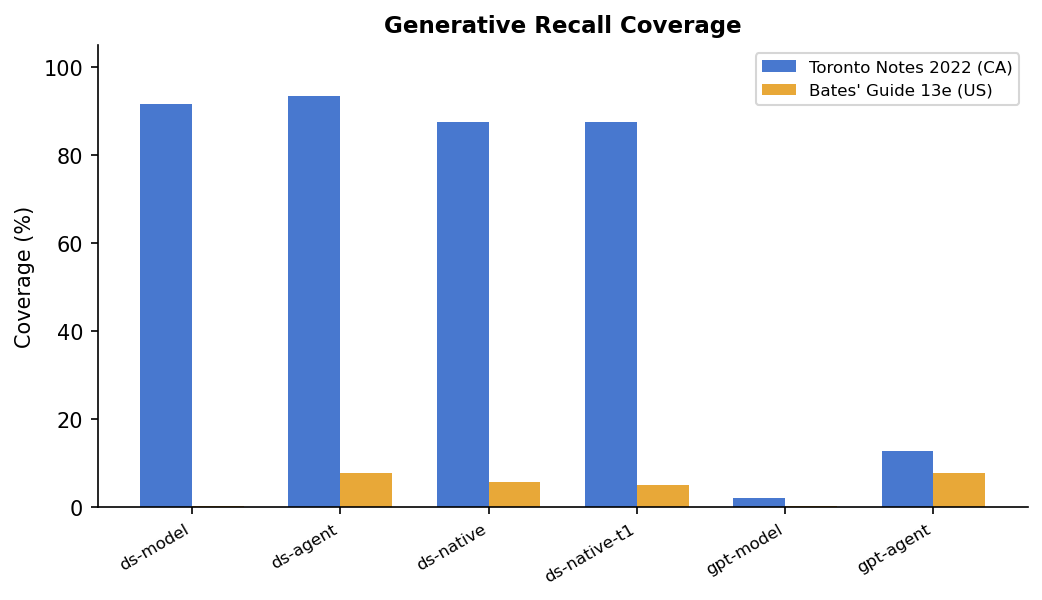
Mean coverage per deployment for each text.
DeepSeek recovers the Toronto Notes table of contents at high coverage (87–93%) across all four DeepSeek deployments. Coverage of the Bates’ Guide table of contents is near zero for the same deployments (0.1–7.7%). The asymmetry is specific to DeepSeek: both GPT-OSS deployments fail generative recall for either text. Despite high mean coverage, no run across any deployment or text achieved complete recall (perfect recall rate = 0% throughout); the model reliably returns most headings per run but consistently omits at least one.
Source identification (table of contents to title)
Deployments were shown the full table of contents of each work — with the title withheld — and asked to name the source. The test was run twice: once with the TOC headings in their published order, and once with the order randomized. Queries for the Canadian text were framed as “[a Canadian medical reference or textbook]”; queries for the American text as “[an American medical reference or textbook]”. The figure reported is the fraction of successful runs on which the model named the correct title.
Table — Source Identification Rate
| Deployment | TN 2022 — Ordered TOC | TN 2022 — Shuffled TOC | Bates’ 13e — Ordered TOC | Bates’ 13e — Shuffled TOC |
|---|---|---|---|---|
deepseek-model | 100% | 100% | 100% | 100% |
deepseek-agent | 100% | 100% | 100% | 100% |
deepseek-native | 100% | 100% | 100% | 100% |
deepseek-native-t1 | 100% | 100% | 100% | 98% |
gpt-oss-model | 0% | 0% | 39.5% | 9.5% |
gpt-oss-agent | 0.5% | 1% | 46% | 39% |
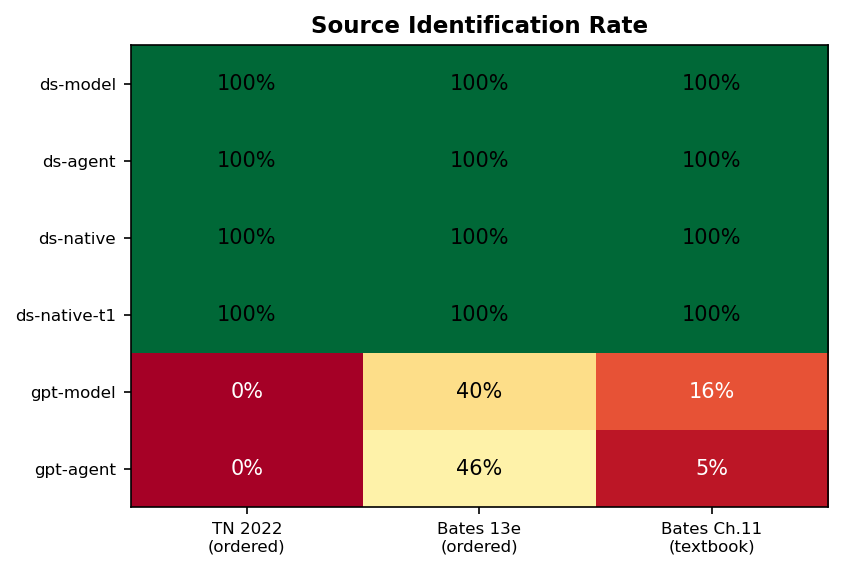
Fraction of runs with correct source identification, by deployment, text, and input order.
From the ordered TOC: DeepSeek identifies both works at 100% on every deployment. GPT-OSS shows the reverse pattern from generative recall: it almost never identifies Toronto Notes (0–0.5%) but identifies Bates’ Guide in 39.5–46% of successful runs.
Shuffling the TOC (removing ordering cues) has no effect on DeepSeek for either text, except for a marginal drop in deepseek-native-t1 on Bates’ (100% → 98%). GPT-OSS is more sensitive: Toronto Notes rates remain near zero on both inputs, but Bates’ rates fall substantially (gpt-oss-model: 39.5% → 9.5%; gpt-oss-agent: 46% → 39%), indicating that part of GPT-OSS’s recognition of Bates’ Guide depends on the ordering structure of the table of contents rather than content alone.
Ordering (shuffled table of contents)
Deployments were shown the headings of each table of contents in randomized order and asked to restore them to the correct sequence. Perfect is the fraction of runs with a fully correct ordering; order accuracy is the fraction of ordered heading pairs appearing in the correct relative order.
Table — Table-of-Contents Ordering Accuracy
| Deployment | TN 2022 — Perfect | TN 2022 — Order acc. | Bates’ 13e — Perfect | Bates’ 13e — Order acc. |
|---|---|---|---|---|
deepseek-model | 97.5% | 99.9% | 36.0% | 95.1% |
deepseek-agent | 91.3% | 99.7% | 23.6% | 93.6% |
deepseek-native | 91.0% | 98.6% | 23.5% | 93.5% |
deepseek-native-t1 | 92.5% | 99.5% | 23.0% | 93.5% |
gpt-oss-model | 0% | 39.7% | 0% | 61.2% |
gpt-oss-agent | 0% | 37.5% | 0% | 65.2% |
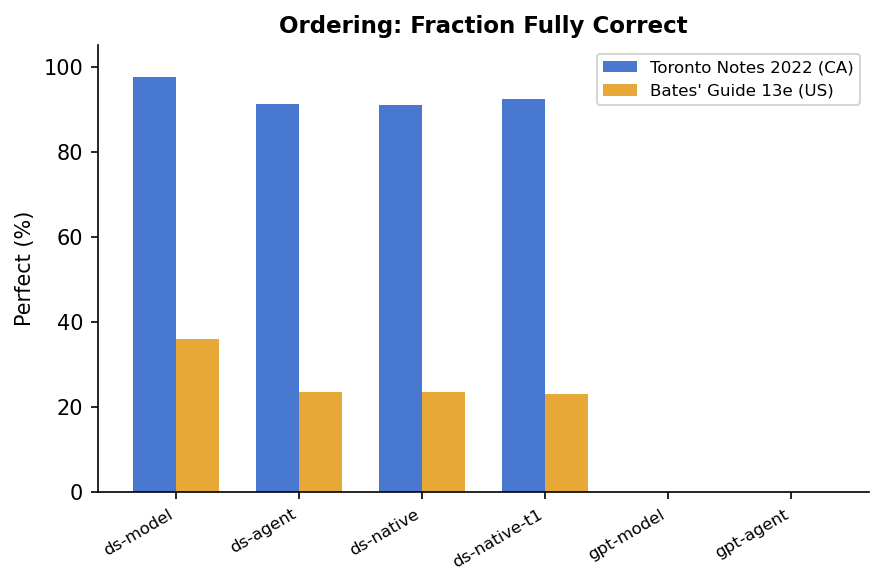
Fraction of runs with fully correct ordering per deployment.
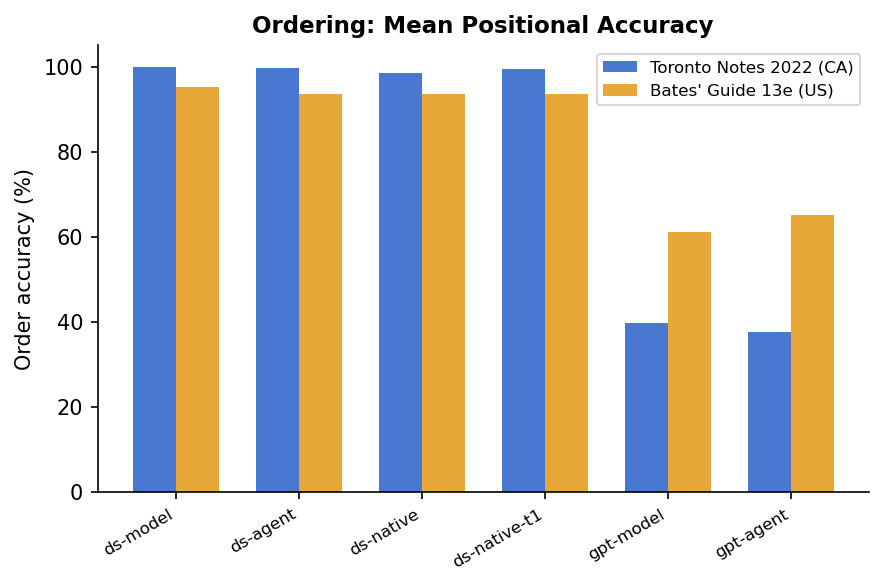
Mean pairwise ordering accuracy per deployment.
DeepSeek achieves near-perfect ordering of the Toronto Notes table of contents (91–97.5% of runs fully correct) but drops substantially on Bates’ Guide (23–36%). GPT-OSS achieves zero perfect orderings for either text, though its mean order accuracy is higher for Bates’ Guide (61–65%) than for Toronto Notes (38–40%), consistent with the identification results above.
Chapter-level results (Bates’ Guide Ch. 11)
The harness also ran four query types against a single chapter of Bates’ Guide 13th Edition, testing behaviour at the section-heading level within a chapter rather than the full book.
Generative section recall
Each deployment was given the chapter title and asked to return its section headings as a list. Coverage is the mean fraction of the reference section headings present in the output.
Table — Generative Section Recall (Bates’ Guide Ch. 11)
| Deployment | Coverage |
|---|---|
deepseek-model | 45.0% |
deepseek-agent | 46.1% |
deepseek-native | 46.5% |
deepseek-native-t1 | 46.1% |
gpt-oss-model | 0.0% |
gpt-oss-agent | 0.1% |
All four DeepSeek deployments achieved 45–46.5% coverage — substantially higher than the near-zero book-level recall of Bates’ Guide, but still well below the Toronto Notes book-level recall (87–93%). GPT-OSS remains at near-zero (0–0.1%), consistent with its book-level result.
Chapter and textbook identification
Deployments were shown the full list of section headings for the chapter — with the chapter title withheld — and asked to name the chapter and the textbook. The test was run with section headings in their published order and with the order randomized.
Table — Chapter/Textbook Identification (Bates’ Guide Ch. 11)
| Deployment | Ordered sections — Textbook hit | Shuffled sections — Textbook hit |
|---|---|---|
deepseek-model | 100.0% | 82.8% |
deepseek-agent | 100.0% | 100.0% |
deepseek-native | 100.0% | 91.5% |
deepseek-native-t1 | 100.0% | 89.0% |
gpt-oss-model | 16.0% | 0.0% |
gpt-oss-agent | 5.0% | 8.0% |
No deployment identified the specific chapter in either condition (chapter identification rate: 0% for all deployments and both input orders). Figures shown are the fraction of runs on which the model named the correct textbook.
DeepSeek correctly identified the textbook from ordered section headings in 100% of runs; shuffled input reduces this to 83–100% depending on deployment. GPT-OSS identified the textbook in only 5–16% of runs from ordered headings, dropping to 0–8% from shuffled headings.
Section ordering
Deployments were shown the chapter’s section headings in randomized order and asked to restore the correct sequence.
Table — Section Ordering Accuracy (Bates’ Guide Ch. 11)
| Deployment | Perfect | Order acc. |
|---|---|---|
deepseek-model | 0.5% | 76.2% |
deepseek-agent | 1.5% | 75.7% |
deepseek-native | 0.5% | 76.8% |
deepseek-native-t1 | 1.0% | 76.1% |
gpt-oss-model | 44.0% | 92.3% |
gpt-oss-agent | 60.5% | 93.6% |
The ordering results reverse the book-level pattern. GPT-OSS achieves 44–60.5% perfect orderings with 92–94% mean order accuracy, while all four DeepSeek deployments fall below 2% perfect with 75–77% mean order accuracy. This reversal is consistent with GPT-OSS having sufficient knowledge of Bates’ Guide content to order sections within a chapter — a task that requires knowing the sequence of a specific chapter’s content — even though it cannot reproduce that structure generatively or reliably identify it from a full book-level TOC.
Overview heatmaps
The following figures show all query types and deployments together for each of the three texts. Each cell reports the primary metric for that query type: coverage (%) for recall tasks, title or textbook hit (%) for identification tasks, and perfect ordering (%) or pairwise order accuracy (%) for sequencing tasks.
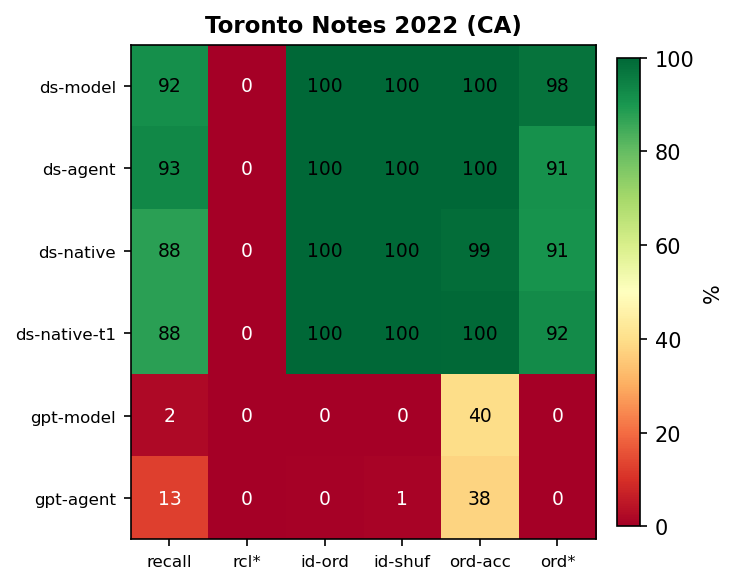
Fig 5a — All query types × all deployments for Toronto Notes 2022.
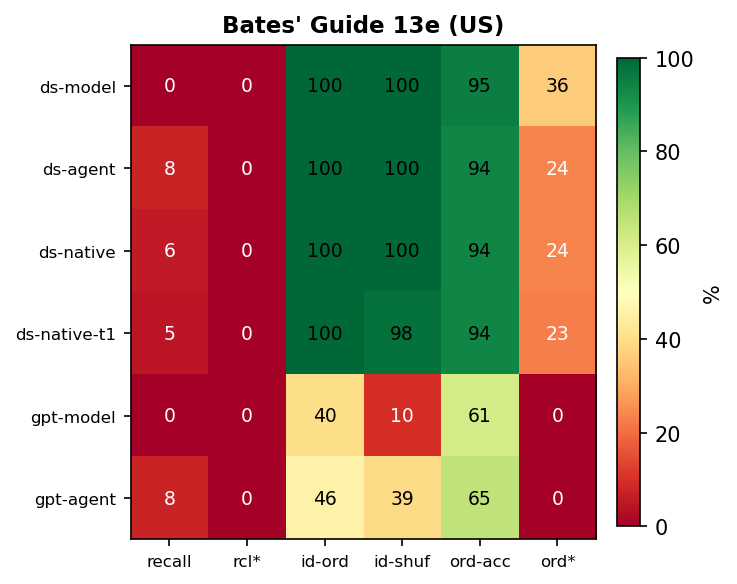
Fig 5b — All query types × all deployments for Bates’ Guide 13e.
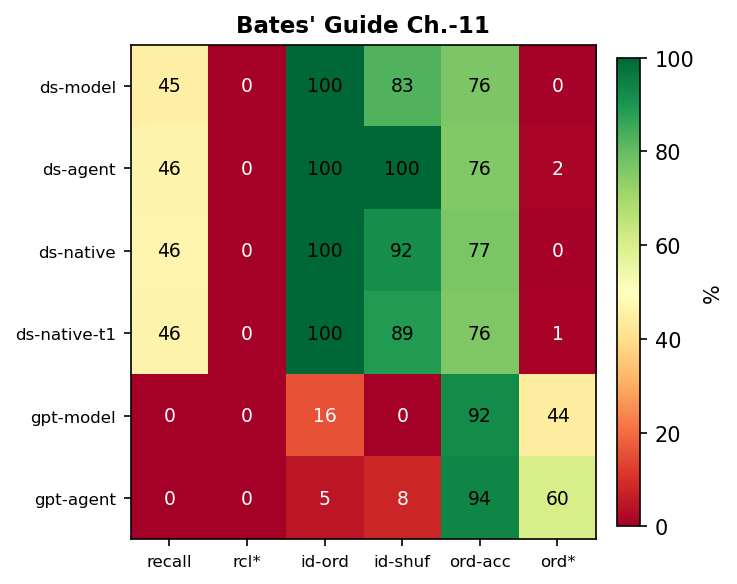
Fig 5c — All query types × all deployments for Bates’ Guide Ch. 11.
Interpretation
The results across all three task types point to an asymmetry in training data coverage rather than a localization or spelling artifact. DeepSeek-V4-Pro shows strong memorization of the Toronto Notes structure — it can reproduce the table of contents from the title, identify the work from its headings, and correctly re-order shuffled headings — while showing near-zero generative recall of Bates’ Guide despite being able to identify it. This is consistent with Toronto Notes being a frequently distributed Canadian reference well represented in Canadian web content that formed part of the model’s training corpus.
GPT-OSS-120b shows the complementary pattern on identification tasks: it almost never names Toronto Notes but identifies Bates’ Guide in roughly 40% of runs. This is consistent with a training corpus in which the American reference was more prominent. Neither model achieves generative recall of Bates’ Guide, suggesting that recognition of a work and verbatim reproduction of its structure are dissociable and can reflect different exposure thresholds in training data.
See Interpretation for the full analysis.